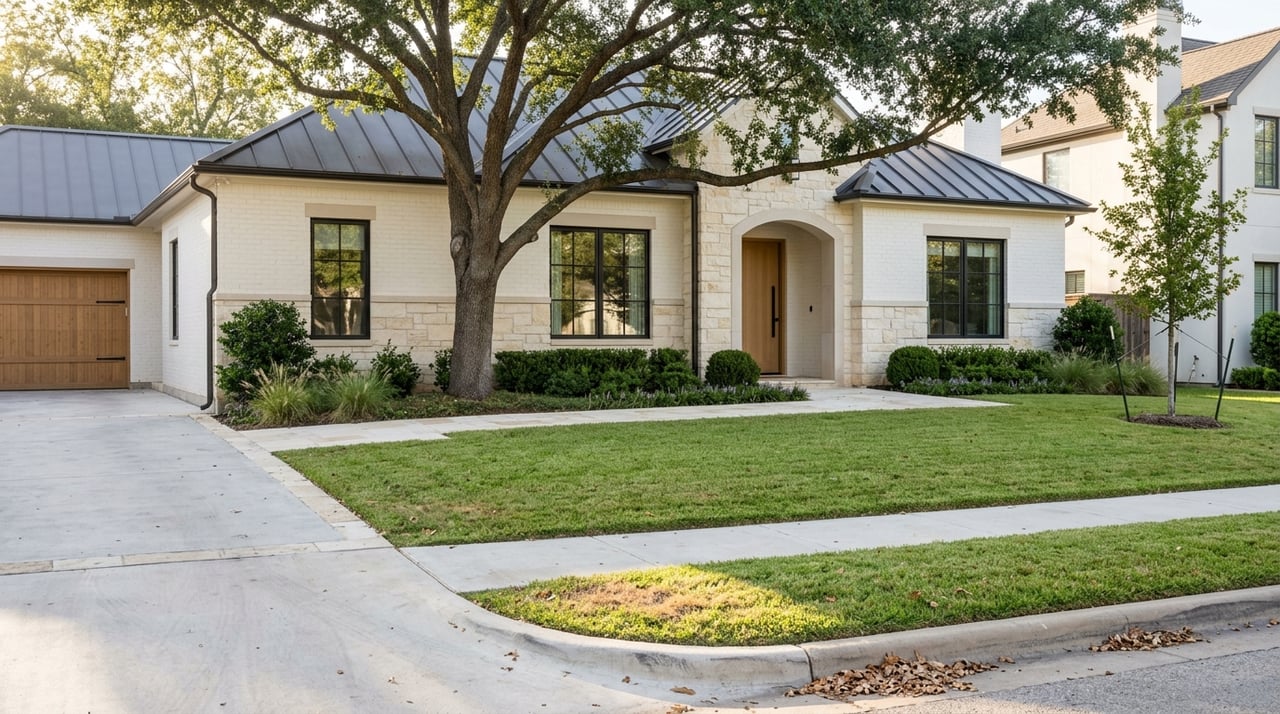
Keller Custom Homes Guide: Custom vs. Production
June 18, 2026
June 18, 2026
Trying to choose between a custom home and a production home in Keller? It sounds simple at first, but in this market, the decision affects your budget, timeline, lot options, and long-term resale more than many buyers expect. If you want a home that fits your lifestyle and your investment goals, it helps to understand how Keller’s land supply, zoning, and approval process shape the tradeoffs. Let’s dive in.
Keller is not a blank-slate growth market with endless new land. The city reports 47,516 residents across 18.4 square miles, and its buildout analysis says a majority of Keller may be built out in less than 10 years based on remaining developable parcels and growth assumptions. That makes lot selection, neighborhood fit, and resale positioning especially important.
Keller also sits in a higher-value housing environment. Census QuickFacts lists a median owner-occupied housing value of $557,700 for 2019 through 2023. In practical terms, when values are already elevated, small differences in lot quality, design fit, and comparable sales can have a bigger impact on what feels like a smart buy.
A custom home is typically a one-of-a-kind build designed around your lot, your layout priorities, and your preferred finishes. This path gives you more control over the final product, especially if you want a very specific look, orientation, or use of space.
A production home is usually built by a community-style builder using a set group of floor plans, elevations, and upgrade packages. You often still get choices, but the process is more standardized and the level of customization is more limited.
In Keller, both options can make sense. The better fit often depends less on style alone and more on the lot, the zoning, the budget, and your timeline.
Keller’s zoning allows for a wide range of single-family lot sizes. The city’s development code includes districts such as SF-36 with 36,000-square-foot lots, 140-foot minimum width, and 200-foot minimum depth, SF-15 with 15,000-square-foot lots, and SF-8.4 with 8,400-square-foot lots. Impervious lot coverage is also capped differently, ranging from 30% in larger-lot districts to 35% or 40% in smaller-lot districts.
That matters because the lot determines how much house and outdoor space can realistically fit. Your home footprint is only part of the picture. In Keller, site planning may also need to account for driveways, walkways, pools, decks, and accessory structures when calculating impervious coverage.
Custom homes usually make the most sense when you are buying or building on a larger parcel. A wider and deeper lot can create more flexibility for:
On these larger lots, the land itself supports the value of a more tailored design. You are not just customizing the house. You are customizing how the house lives on the property.
Production homes often fit more naturally on smaller, already platted lots where standardized plans can be repeated efficiently. If you want a straightforward path and do not need to reinvent the layout, a production-style home may deliver the right balance of function, finish, and speed.
This can be especially appealing if your top goals are a simpler purchase process, fewer design decisions, and a home that aligns closely with what other buyers in the area also expect.
One of the biggest misconceptions about custom homes is that more budget automatically means unlimited freedom. In Keller, the city process adds clear guardrails, even on highly personalized projects.
The city requires an approved final plat before a building permit is issued, even for tracts that match Tarrant Appraisal District dimensions but have not been formally platted. The city also reviews plans and permits in the order they are received once the application is complete.
For some projects, the Development Review Committee may review concept plans with planning, building inspections, economic development, fire, parks, police, and public works staff. Residential site-plan submittals can include elevations, a landscape plan, a photometric plan, and a tree survey or preservation plan.
If you are considering custom in Keller, ask early questions about:
These factors can narrow your realistic options quickly. They can also affect timeline and total cost long before construction begins.
For many buyers, this is the core tradeoff.
Production homes usually offer more budget certainty because the builder uses repeat plans, standardized systems, and a narrower menu of options. With fewer moving parts, pricing is often easier to understand from the beginning.
Custom homes usually involve more design decisions, more specialized sourcing, and more chances for changes during the process. If you adjust materials, layout, or structural features after plans are underway, costs can move with them.
If you value clarity and predictability, production may feel more comfortable.
If you value control and personalization, custom may be worth the added complexity.
Neither path is automatically better. The right answer depends on how much flexibility you want in your design and how much flexibility you can tolerate in your total spend.
Timing is another major separating factor.
NAHB reported that the average time to complete a single-family home in 2023 was 10.1 months, while homes built for sale averaged 8.9 months. Realtor.com’s 2025 comparison also noted that quick-move-in spec homes can sometimes close in 30 to 90 days when they are already near completion.
In Keller, the gap can feel even wider when a custom build starts with raw land or an unplatted tract. Between platting requirements, review steps, site-plan details, and permit timing, a more personalized project can involve more pre-construction work before the home itself really gets underway.
A production or quick-move-in home usually gives you the clearest path. You may give up some design freedom, but you gain time and often reduce the number of unknowns.
A custom home may still be the better fit, especially if you are focused on a specific lot, a multigenerational layout, or architectural features that are hard to find in standard inventory.
A custom home may feel more special, but special does not always mean easier to price later.
The Appraisal Institute explains that appraisers rely on similar sales in the area and use a sales-comparison approach centered on nearby comparable properties. When a home is highly unique, there may be fewer direct comps to support value in a resale or appraisal setting.
Production-style homes often have more predictable resale because they are designed for broader market appeal and tend to align more closely with nearby comparable sales. In Keller, that can matter because limited land supply and varying lot sizes already make value comparisons more nuanced.
A well-executed custom home on a premium lot can perform very well. That is especially true when the design feels intentional, functional, and in step with what buyers expect for the area.
The greater resale risk usually comes from choices that are too personal or too hard to compare. An unusual layout, overly specific finish selections, or a design that does not fit the surrounding market can make pricing more difficult.
Before you decide between custom and production, start with the property realities. In Keller, the smartest first questions are usually not about countertops or exterior style. They are about whether the lot actually supports what you want to build and how the city process may affect your plan.
That is where local guidance can save time. If you understand the lot, the zoning, the plat status, and the resale picture early, you can make a cleaner decision and avoid chasing options that do not fit the site.
In a market like Keller, where land is limited and values are meaningful, the best choice is usually the one that matches both your lifestyle and the property itself. If you want expert guidance on evaluating lots, new construction options, or resale value in Keller, connect with Marcontell-Gilchrest Group.
Stay up to date on the latest real estate trends.
Experience the winning combination of Marcontell-Gilchrest Group, with over $2 Billion+ in successful transactions and 30+ years of expertise, we are your ultimate partners in buying or selling a home. We are uniquely qualified to assist Sellers in positioning and marketing homes in today’s competitive environment and write winning offers for Buyers. Discover the power of our diverse backgrounds and award-winning talents. Choose us for your Real Estate buying or selling needs!